Killing Fields of Scotland by Pugh R J M
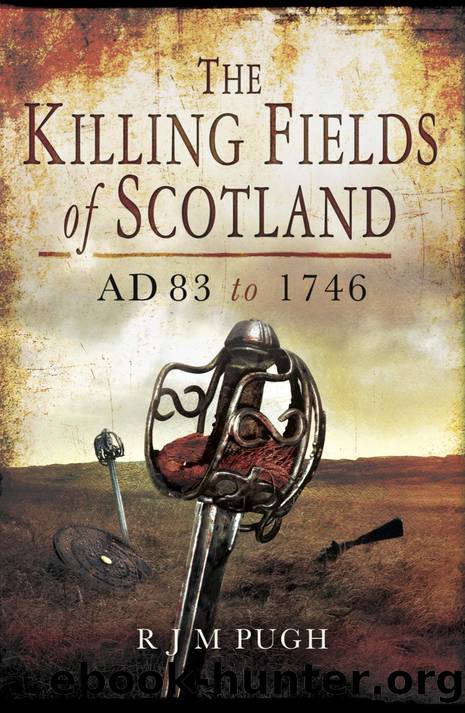
Author:Pugh, R J M
Language: eng
Format: epub
ISBN: 9781783469888
Publisher: Pen and Sword
Published: 2013-09-09T16:00:00+00:00
Pinkie Cleugh, known as Black Saturday, was the worst disaster in Scotland’s history since Flodden. The day after the battle Leith was committed to the flames, then Broughty Castle, near the mouth of the Tay; the island strongholds of Inchcolm and Inchkeith were slighted in September, followed by the occupation of all of Annandale by the Earl of Wharton. Before these events, however, Somerset had been recalled to England on pressing political affairs. The main objective of Pinkie had not been achieved, however; the Scots had no thought of seeking peace with England by giving up their young Queen.
After his defeat Arran had little option other than to turn to France and renew the Auld Alliance which he negotiated in December 1547. As a condition, however, he was requested to hand over certain important castles including Dunbar, Eyemouth and Inchcolm; the French set about creating a defensive chain of forts along the east coast of Scotland which incorporated these strongholds. Then, in April 1548, Lord Grey of Wilton, Somerset’s cavalry commander at Pinkie, occupied Haddington; Grey believed ‘the keeping of Haddington to be the winning of Scotland’ which, to modern eyes, seems something of a spin on his modest achievements in Scotland. No matter, Grey spent the next two months fortifying the market town; by the end of June he was surrounded by 14,000 French and Scottish troops commanded by Andre Montalembert, Sieur d’Esse. The Treaty of Haddington signed by France and Scotland on 6 July promised Mary, Queen of Scots to the Dauphin François, heir to the throne of France and only son of Henri II and Catherine de Medici.
The siege of Haddington would last from June 1548 to September 1549. For his part, Grey delegated the command at Haddington to Sir James Wilford so that he could direct operations from Berwick. On 7 July Grey was able to despatch 2,000 troops with powder and shot to Haddington but only 400 managed to get inside the town walls. Another relief column of 15,000 led by the Earl of Shrewsbury found that Haddington was in no danger of capitulating, so Shrewsbury returned to Berwick, torching Dunbar yet again. Before returning over the Border, Shrewsbury rebuilt and strengthened the fortalice of Dunglass and installed a garrison of 3,000 German mercenaries to defend the area, a forward thinking measure to cover the inevitable withdrawal of the English troops from Haddington in the autumn of 1549. In England a court coup toppled Somerset and the war virtually came to a close. Somerset was executed; the war he had so ruthlessly prosecuted against Scotland seemed to have achieved nothing save death, misery and poverty for the people of south-east Scotland.
In the spring of 1550 England and France signed the Treaty of Boulogne on 24 March which brought a welcome respite to the Scots; part of the treaty stipulated that England would relinquish any Scottish strongholds still in its possession. Further, the main castles would be garrisoned by French soldiers which did not sit well altogether with the Scots.
Download
This site does not store any files on its server. We only index and link to content provided by other sites. Please contact the content providers to delete copyright contents if any and email us, we'll remove relevant links or contents immediately.
| Africa | Americas |
| Arctic & Antarctica | Asia |
| Australia & Oceania | Europe |
| Middle East | Russia |
| United States | World |
| Ancient Civilizations | Military |
| Historical Study & Educational Resources |
Room 212 by Kate Stewart(5119)
The Crown by Robert Lacey(4814)
Endurance: Shackleton's Incredible Voyage by Alfred Lansing(4780)
The Iron Duke by The Iron Duke(4354)
The Rape of Nanking by Iris Chang(4211)
Joan of Arc by Mary Gordon(4109)
Killing England by Bill O'Reilly(4001)
Say Nothing by Patrick Radden Keefe(3983)
I'll Give You the Sun by Jandy Nelson(3445)
Shadow of Night by Deborah Harkness(3366)
Hitler's Monsters by Eric Kurlander(3341)
Mary, Queen of Scots, and the Murder of Lord Darnley by Alison Weir(3210)
Blood and Sand by Alex Von Tunzelmann(3203)
Eleanor & Park by Rainbow Rowell(3169)
Darkest Hour by Anthony McCarten(3129)
Margaret Thatcher: The Autobiography by Thatcher Margaret(3081)
Book of Life by Deborah Harkness(2937)
Red Famine: Stalin's War on Ukraine by Anne Applebaum(2932)
The One Memory of Flora Banks by Emily Barr(2863)
